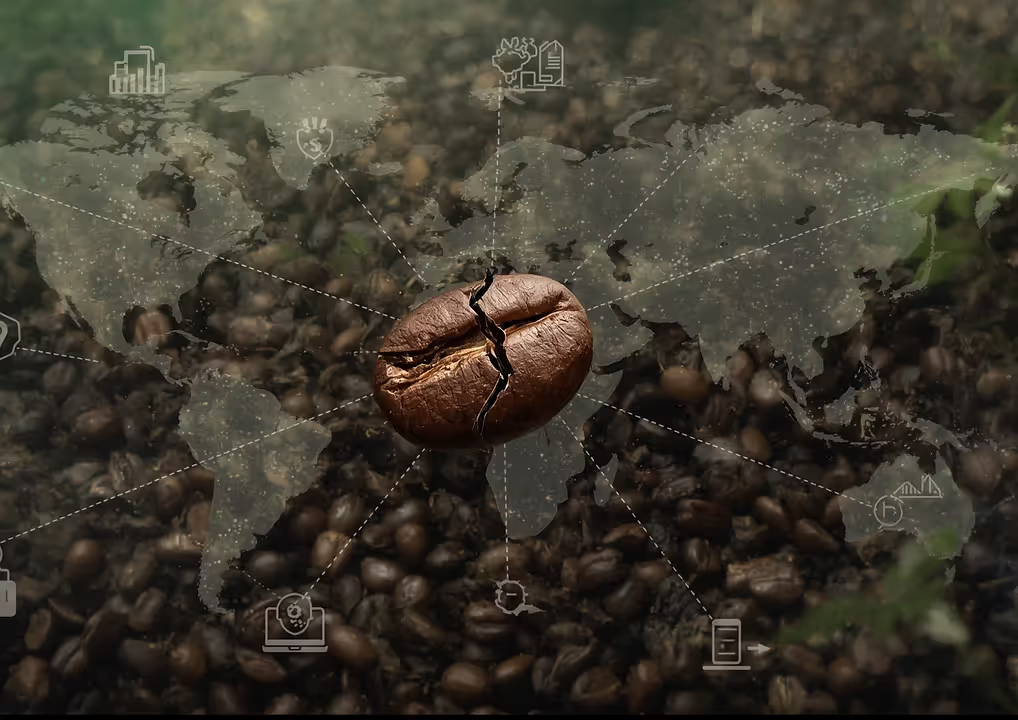
Some software projects begin with a feature list. Others begin with an industry that has been operating in broadly the same way for decades and the ambition to rethink it from first principles.
Alcomex belongs to the second category.
Created to make international green-coffee trading more transparent, efficient and equitable, Alcomex is not simply a marketplace. It is digital infrastructure for a process in which agreements, documents, identities, funds and physical goods move through different systems and jurisdictions.
Building it required much more than adding blockchain to a web application. It required product strategy, domain modelling, experience design, backend engineering, smart-contract development and a careful understanding of where trust should live.
This is the kind of challenge we love at AELIG: technically ambitious, operationally complex and connected to a mission with tangible value.
Suggested image: A strong hero image combining the Alcomex interface with the physical coffee supply chain. Avoid generic blockchain graphics; show the real platform and the real industry.
From fragmented processes to one digital flow
International commodity trading is a chain of dependencies. An exporter and an importer must agree on commercial terms. Companies and authorised users need to be identified. Documents must be uploaded, reviewed and associated with the correct deal. Conditions need to be fulfilled. Funds must remain protected until the agreed requirements are met. Every relevant action must be visible to the right people and restricted from everyone else.
In the traditional model, much of this coordination happens through email threads, manually exchanged files, disconnected records and intermediaries. Alcomex describes contracts involving as many as 20 paper-based documents. The result is not only administrative friction: fragmented information makes transactions harder to verify, increases the opportunity for mistakes and complicates traceability across the supply chain.
The challenge was not “put the coffee trade online.” It was to translate a multi-party commercial process into a reliable workflow without flattening the real-world complexity behind it.
That distinction shaped the entire platform.
One product, three deeply connected systems
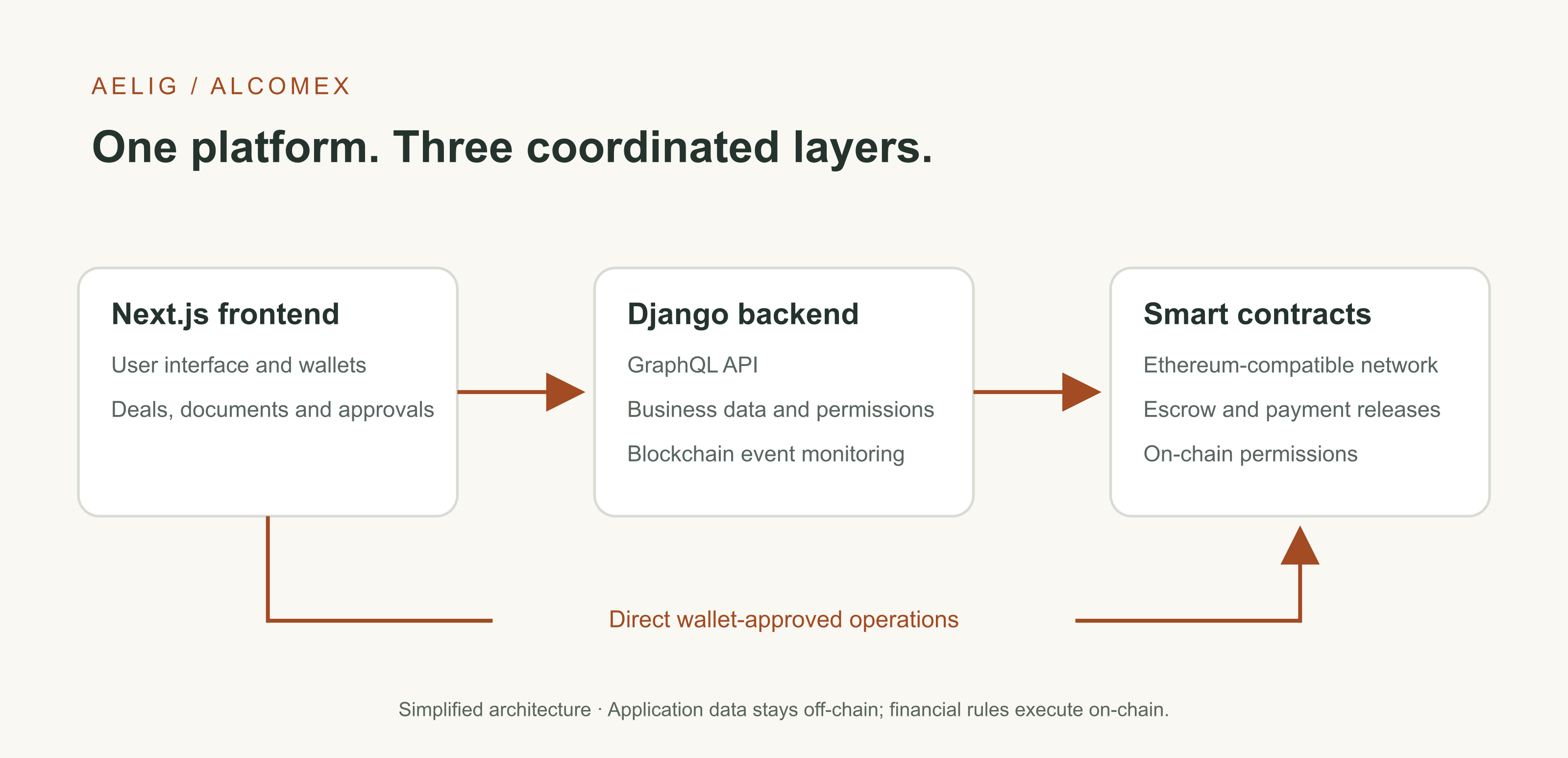
Alcomex is built across three coordinated technical layers.
The user-facing application uses Next.js 15, React and TypeScript, supported by Tailwind CSS and Shadcn UI. This layer gives importers, exporters, companies and administrators a clear interface for onboarding, deal management, documents, wallet connections and transaction approvals.
The application backend uses Python, Django, Graphene-Django and GraphQL. It manages centralised business data such as users, organisations, company relationships, deal metadata, documents and operational permissions. It also monitors blockchain events and reconciles relevant on-chain activity with the application’s internal state.
The trust-critical financial layer uses Solidity, Hardhat and OpenZeppelin on an Ethereum-compatible network. Its smart contracts manage company wallets, role-based permissions, escrow deposits and payment releases. Support for EIP-2771 meta-transactions helps reduce one of Web3’s most persistent usability barriers by enabling gasless interactions for supported operations.
This division is deliberate. Putting everything on-chain would be expensive, inflexible and unnecessary. Keeping everything in a conventional database would weaken the guarantees required for funds and transaction-critical rules. Alcomex uses a hybrid architecture so that each responsibility lives in the layer best equipped to handle it.
That is mature blockchain software development: not decentralisation as a slogan, but a precise decision about what needs to be decentralised and what does not.
The complexity is in the coordination
Each layer is sophisticated on its own. The real engineering challenge emerges where they meet.
Consider funding a deal. The importer must be authenticated and authorised, the agreement must be in the correct state, and a compatible wallet must use the correct network. The user may need to approve an ERC-20 token before depositing stablecoins into escrow. The transaction can be rejected, remain pending or revert. Once confirmed, the backend must observe the event and update the deal without creating a misleading state in the interface.
Now multiply that coordination across onboarding, company wallets, document exchange, commercial milestones, confirmations, permission changes and the final release of funds.
A change to an escrow condition can affect a Solidity contract, emitted events, backend monitoring, GraphQL types, frontend state and user permissions. There is no “small change” when several sources of truth must remain consistent.
Complex product engineering demands architectural discipline. Interfaces must remain synchronised, on-chain and off-chain state must converge safely, and failed transactions must be recoverable. Frontend validation should guide the user without pretending to replace the smart contract’s authority.
The more effortless the finished interaction appears, the more engineering has usually happened underneath it.
Designing trust without exposing the machinery
Blockchain products often ask users to understand the technology before receiving its benefits. For a professional trading platform, that is the wrong way around.
Alcomex uses Sign-In with Ethereum (SIWE) to authenticate users through a verified wallet signature. WalletConnect-compatible providers connect supported wallets, while the platform translates contract interactions into commercial actions. Importers fund escrow; exporters receive payments; authorised parties complete deal conditions. Users should not need to interpret contract ABIs or event logs to know what happens next.
The same principle applies to permissions. Users act on behalf of a company, within a particular deal, at a valid lifecycle stage and under the applicable role. Application controls and smart-contract rules work together so that convenience does not replace authority.
For us, excellent UX is not decoration placed over technical complexity. It is the work of absorbing that complexity on the user’s behalf.
Suggested image: An anonymised deal screen showing the transaction status, required documents, milestones and a clear next action.
Escrow as an operational workflow not a button
Once a commercial agreement is accepted, the importer can deposit ERC-20 stablecoins into a deal-specific smart contract. Those funds remain locked while the transaction progresses through its required conditions. Milestones can represent events such as document completion, goods receipt or sample approval. Only when the relevant conditions are satisfied can the funds be released to the exporter’s company wallet.
Behind this linear journey sits a distributed state machine. It must protect funds, prevent unauthorised releases, communicate pending states and align the platform’s central record with the blockchain. It must also handle network changes, delayed confirmations, rejected signatures and failed transactions.
Solving those cases is not peripheral work. It is the difference between a proof of concept and software that can support serious commercial activity.
A living workspace for international trade
International trade also runs on information. Alcomex brings companies, users, deals and business documents into a structured workspace. Centralised storage and metadata keep files practical to manage, while deal states and permissions determine which actions are available. Blockchain events provide a verifiable record where stronger guarantees are needed.
Documents do not need to be stored on-chain to benefit from a blockchain-backed transaction model. The platform uses the appropriate infrastructure for each kind of data, then presents it as one coherent product in which participants can see the evidence, completed actions and next steps.
Building a sandbox where people can learn by doing
Complex platforms need more than a polished production environment. They need a safe place for adoption.
Alcomex includes an isolated sandbox where prospective users can experience the complete workflow without affecting real transactions. It mirrors production while connecting to a test blockchain, allowing companies to create operations and simulate transaction flows with non-production assets.
Trust in new infrastructure cannot be created through a slide deck alone. Importers and exporters need to explore how responsibilities move between parties and how blockchain-backed actions behave. A read-only demo explains a product; an interactive sandbox makes it tangible.
Designing both environments reflects a broader principle: adoption is part of the product. Testing, training and commercial demonstrations should not be improvised after engineering is complete.
Our approach: technical depth, curatorial care
At AELIG, our approach is curatorial because building an ambitious product is partly an act of selection.
Not every possible feature deserves to exist, not every process should move on-chain, and not every technical novelty improves the experience. Our role is to understand the domain, identify what creates value and give every layer the attention it deserves.
For Alcomex, that meant auditing the earlier platform developed with SUPSI, then rethinking and simplifying the product around its essential workflows. We moved continuously between commercial requirements and implementation details—from how two companies form a deal to how a smart-contract event becomes a trustworthy interface status.
It also meant staying close throughout reviews, refinements and demonstrations. Meaningful digital transformation cannot be handed over as a black box. Strong products emerge through sustained collaboration, honest prioritisation and shared ownership.
That combination, engineering rigour and human proximity, is where AELIG does its best work.
Suggested image: A real workshop, review session or product demonstration with the AELIG and Alcomex teams. Authentic collaboration will communicate the “curatorial” approach better than stock photography.
Technology should improve the system it enters
We are selective about our projects. Complexity alone is not enough; we seek technology that creates concrete value and contributes to a positive mission.
The coffee trade is economically important and deeply human, yet its information flows can remain opaque and fragmented. Better traceability can make records easier to verify, support origin and environmental-impact requirements and give participants a clearer view of each transaction. Direct digital processes can reduce avoidable friction between producers, exporters and importers.
Software cannot make a supply chain fair or sustainable by declaration. It can, however, create infrastructure for accountability: clearer provenance, verifiable actions, protected payments and inspectable information.
That is the promise we see in Alcomex. It applies advanced technology to a real economic system—not to make that system look futuristic, but to make it work better.
The kind of rocket science we choose
Alcomex brought together product design, frontend engineering, backend architecture, GraphQL APIs, smart contracts, wallets, stablecoin escrow, gasless transactions, documents, permissions and blockchain synchronisation. The achievement was making these disciplines operate as one understandable platform.
This is our definition of “rocket science” at AELIG. It is not complexity performed for effect. It is the ability to enter a difficult domain, model it carefully, choose the right technologies and turn a large system into an experience people can actually use.
We are proud of the engineering behind Alcomex. We are equally proud of the purpose behind it: increasing transparency in an industry where better information, stronger trust and more accountable transactions can create meaningful impact.
If your organisation is working on an ambitious digital product, especially one involving complex workflows, blockchain infrastructure or multiple sources of truth, we would love to hear about it.